Your business is the one asset whose value you control. Do you know what it's worth?

Most owner-operators across the region can grow the top line. The struggle is scaling — getting the company to grow without everything still running through them. And most still don't know what the business is actually worth.

I help owners find out what their business is worth today, what it needs to be worth, and how to close the gap so the company can scale — and someday transfer — without depending on them for every job, every customer, and every problem.

Most owners I meet are only interested in top-line revenue — at least until we sit down together. Revenue is the scoreboard everyone asks about. The number that funds an exit is different: the profit, the systems, and what a buyer would actually pay.

Start Your Wealth Gap Assessment

Complimentary. Confidential. About 60 minutes.

Or get the free guide →

Business Valuation · Exit Planning · Succession Planning

Aisle in a distribution warehouse, with pallets on high shelving
A distribution warehouse — not a client facility. Photo: imeenhae / Pexels.

The Wealth Gap

Here's the math nobody does until it's too late.

What you need to walk away
− What a buyer would pay today
= Your Wealth Gap

For most owners I meet, that gap is bigger than they think. Not because the business is bad, but because:

01

It runs on you.If you're the one who quotes the jobs, knows the customers, and fixes the problems, a buyer isn't paying for a company. He's paying for a job he has to do himself. He'll discount it accordingly.

02

The books tell a story only you can read.Add-backs, family on payroll, trucks run through the business. A buyer's accountant has three days to figure it out. If he can't, he assumes the worst.

03

Two or three customers are most of the revenue.Every buyer asks the same question: what happens when one leaves?

04

There's no bench.Nobody on the team could run it for 90 days without calling you.

None of that shows up on your P&L. All of it shows up in your sale price.

The good news: every one of those is fixable. Fixing them can change the multiple a buyer will pay — not just the top-line growth on the P&L.


Three ways I help

Business Valuation

What is it worth right now?

A real number, built from your financials and the drivers buyers actually pay for, not a rule of thumb from a guy at the Rotary. Delivered through my valuation software so we can re-run it any time and watch the number move as you make changes.

Exit Planning

How do you get the most for it?

Whether you're 18 months out or five years out, the buyers who pay the highest multiples are strategic buyers, and they buy differently. As a Certified Succession & Exit Guide and Certified Business Guide, I help you position your company for the buyer who sees it as a growth move, not a purchase price.

Succession Planning

How do you hand it off without breaking it?

Selling to a son or daughter. Selling to your management team. Bringing in a partner. Each one has a different tax bill, a different timeline, and a different set of ways to go wrong. We map the one that fits your family and your numbers.


How it works

Value Engines: a coaching platform, not a coaching program.

Most exit planning is a binder. You get a big report, a few meetings, and then it sits on a shelf while you go back to running the business.

Value Engines is different. It's the system I use with every owner I work with, and it runs on two things:

1

Valuation software that tracks your number.We build your baseline valuation in the first 30 days. From there, the software scores your business on the drivers buyers care about, shows you which ones are dragging the number down, and re-values the company as you fix them. You always know where you stand.

2

A coaching cadence that actually closes the gap.30-, 60-, or 90-day working sessions. One priority at a time. Owner dependence, customer concentration, clean financials, a management bench, recurring revenue. We pick the driver with the biggest payoff, fix it, re-run the number, and move to the next one.

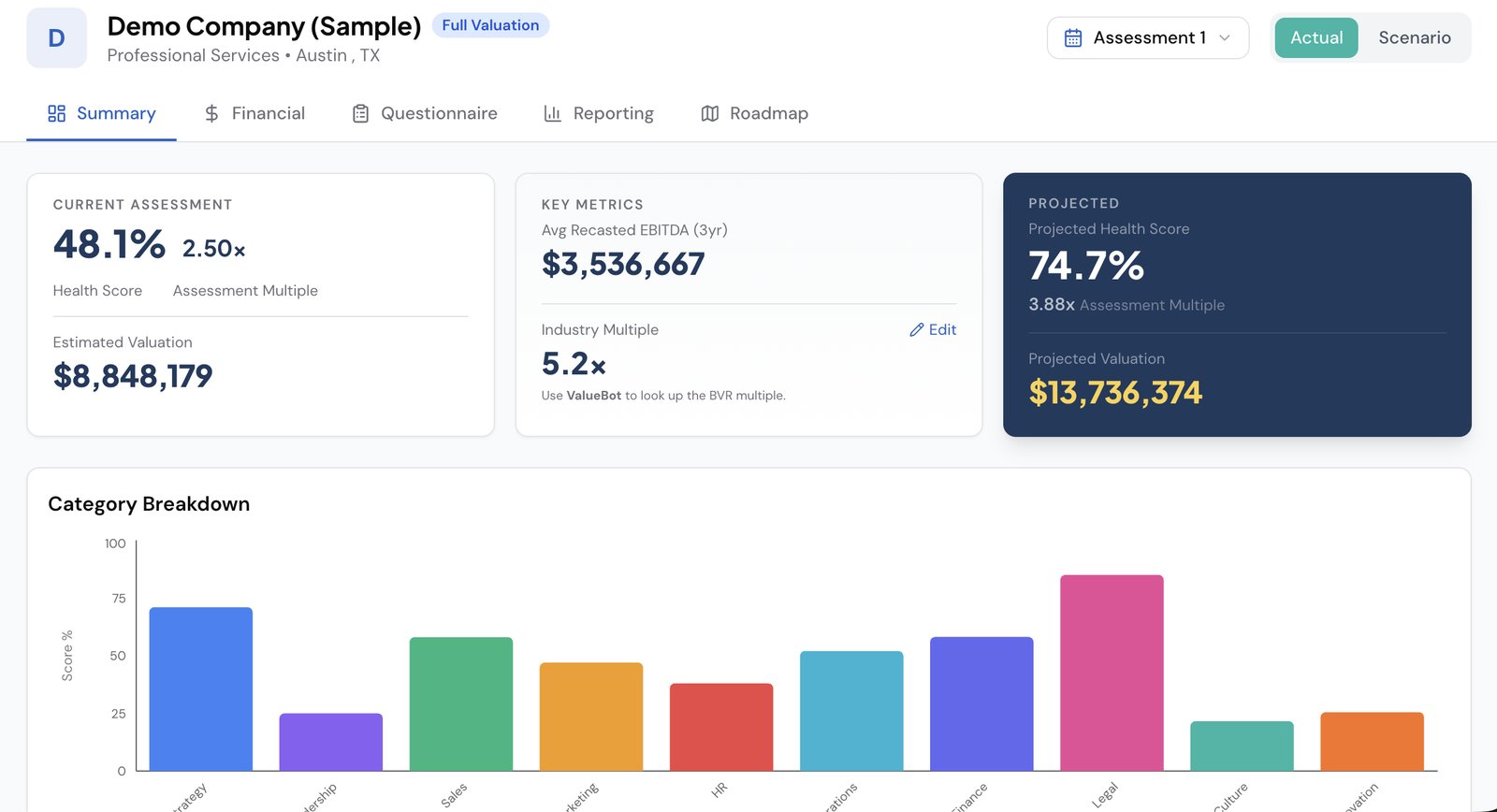
Sample Value Engines dashboard, showing a demo company's health score, valuation range, and category breakdown
A sample company in the Value Engines software — not a client.

What you get

  • Your current valuation and your target number
  • A written plan, in order, with dollar impact attached to each step
  • A dashboard showing the gap closing
  • An owner who's ready when the buyer calls, not scrambling.

Results

The work is measured in years, not in a single workshop.

The kind of company I work with

A regional packaging manufacturer.

A regional packaging manufacturer came to me after an acquisition. Over seven years, with fewer people through automation, annual revenue went from $13 million to $45 million. Their gross profit increased in relation to their revenue.

I was their guide, not the operator. The team did the work. Together we put structure, clear roles, accountability, and a real plan in place, so growth didn't depend on the owners for everything.

7 yrs

Working together

$13M to $45M

Annual revenue, Keith's stated result

Automated bottling line, with green glass bottles on a production line
A generic packaging and automation line — not the manufacturer described here, and not a client facility. Photo: Keegan Checks / Pexels.

A recent exit

TDS IT, Lowell, Arkansas.

Tim Stanley built TDS IT into one of the strongest office-technology companies in Northwest Arkansas. In 2026, he sold it to GFI Digital, a Missouri-based strategic buyer.

Most companies that size sell for lower multiples. The difference wasn't luck. It was 4 years of deliberate work on what makes a business worth more to a strategic buyer than to anyone else.

4 yrs

Of deliberate preparation

2026

Acquired by a strategic buyer

"Four years ago, I didn't feel we could get to a point where we could sell at all. It was about preparedness, not luck. It's worth starting sooner. Having a partner to push you, keep you accountable, and help you navigate growth and exit strategy makes a huge difference. Keith helped me become the owner I always wanted to be. We built the structure, the culture, and the leadership a real buyer wants to see — and we closed a successful exit."
Tim Stanley Tim Stanley
Founder & Strategic Advisor · TDS IT · Acquired by GFI Digital

Another proof point

A former client's exit: $35 million to a $100 million private-equity sale.

I guided a former client from $35 million in annual revenue to a $100 million company and a successful private-equity sale. That engagement is separate from the packaging work above.

Read more from owners I've worked with →


Keith Trost
Keith Trost, Owner and Founder, Elite SUCCEED

About Keith

I've been on your side of the table.

I spent 25+ years as an owner, CFO, and COO in blue-collar businesses. I know what it's like to have every dollar you've got tied up in a company that can't run a week without you.

Since 2017, I've coached leadership teams across the region, based in Fayetteville, as a Certified EOS Implementer and a Founding Pinnacle Business Guide. That work taught me something the valuation textbooks don't: the businesses that sell for the most are the ones that run the best without the owner. Today, that's the whole point of what I do.

Credentials

  • Certified Succession & Exit Guide | Certified Business Guide
  • Certified EOS Implementer™, 2017–2020
  • Founding Member, Pinnacle Business Guides™, 2020–2024
  • Former VP/CFO/COO
  • B.S. Accounting and Business Management, Oral Roberts University
Start a Wealth Gap Assessment →

For advisors — CPAs, attorneys, bankers, wealth managers

Your business-owner clients will exit. Most of them aren't ready.

Two people at a table reviewing a breakeven analysis on a laptop
A working review of the numbers — not Keith or a named advisor. Photo: PNW Production / Pexels.

I work alongside CPAs, M&A attorneys, commercial bankers, and wealth advisors across the region — including Tulsa, Fort Smith, Joplin, Springfield, Wichita, and Kansas City. I don't do your work. I make it easier: a client who knows his number, has clean books, and has a plan is a better client for all of us.

If you have an owner who's 3–5 years from exit and doesn't have a plan, the Wealth Gap Assessment is the easiest first step you can hand them.

A free short guide

Why your revenue isn't your exit number.

Most owners I meet are only interested in top-line revenue — at least until we sit down together. This short guide explains why the top line is the wrong scoreboard for an exit, what buyers actually look at, and how to start closing the Wealth Gap.

Leave your first name and email, and I'll send it to you. When you're ready, book a complimentary Wealth Gap Assessment.

By requesting the guide, you agree to our Privacy Policy.

Find out where you stand.

The Wealth Gap Assessment takes about 60 minutes. You'll leave with a valuation range, the three biggest things pulling your number down, and a straight answer on whether you're on track.

No cost. No pitch. If it makes sense to keep going, we'll talk about that. If it doesn't, you'll still know more about your business than you did when you walked in.

If you have recent financials, have them handy. If you don't, come anyway.

Start Your Wealth Gap Assessment

Or call me directly: 479.313.0173